There's a moment I keep seeing play out across social media. An athlete, smart and dedicated, stacking 10, 15, 20 supplements a day because someone with a podcast told them to. I get it. The messaging is compelling. But here's the reality: most of it is noise, and some of it is genuinely wasting your time and money.
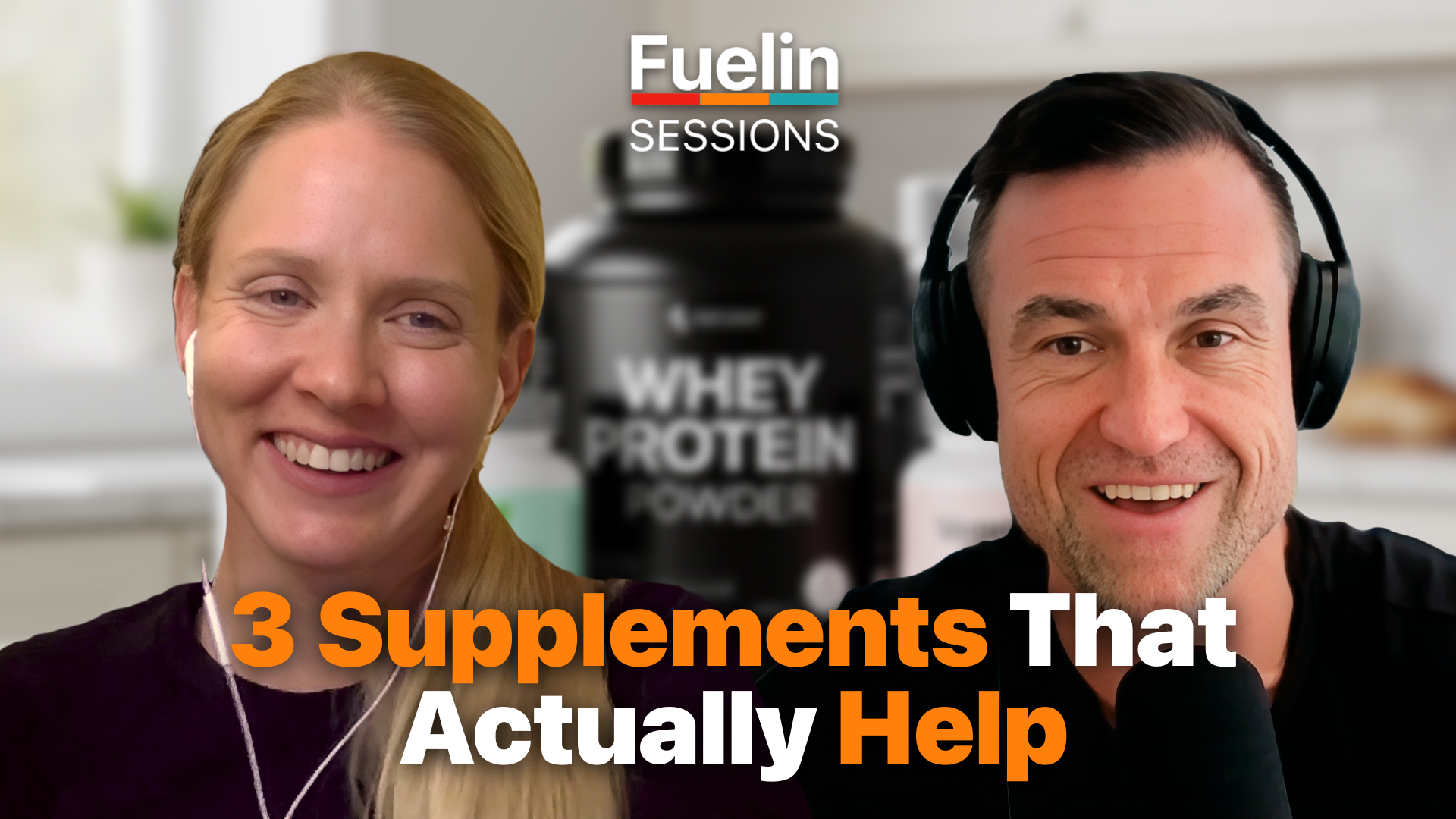
On a recent episode of Fuelin Sessions, I sat down with Megan Foley to cut through the supplement clutter and focus on three that actually matter for endurance athletes: iron, creatine monohydrate, and protein powder. These aren't sexy or revolutionary. But they are evidence-based, and there's a right and wrong way to approach each one.
Before we get into specifics, one principle sits above everything else: food first, not food only. Professor Graeme Close, one of my nutrition lecturers, drilled this into me early on and it has never stopped being true. No supplement will compensate for poor energy availability, low diet quality, or inadequate training. If those foundations aren't solid, you're just decorating a broken house. Supplements fill gaps. They don't build the structure.
Iron: Get Tested Before You Do Anything Else
Iron deficiency is one of the most common and most overlooked issues in endurance athletes, particularly in menstruating women. It affects oxygen transport, so when iron is low, training suffers, recovery stalls, and fatigue becomes chronic. The problem is that these symptoms are easy to dismiss as just "hard training."
What makes iron particularly tricky is the triple threat Megan describes for female runners: menstrual iron losses, foot strike haemolysis (red blood cell destruction from ground contact), and under-fueling. Any one of these is a risk factor. Together, they're a recipe for deficiency that can quietly derail an entire season.
Before touching a supplement, get a full iron panel. Request ferritin, serum iron, total iron binding capacity, transferrin, plus haemoglobin and haematocrit from a full blood count. Add folate and B12 while you're at it, since different types of anaemia have different causes. Serum iron alone tells you very little. Ferritin is the number you want to understand.
On the food side, haem iron from animal sources is significantly better absorbed than plant-based non-haem iron. Liver sits at the top, somewhere between 17 and 30mg per 100g. Clams clock in at around 28mg per 100g. Oysters at 7mg per 100g. A 200g steak is a good source but not the powerhouse most people assume, sitting around 3mg per 100g. Pâté on crackers twice a week is honestly one of the simplest, most practical interventions I recommend for iron-insufficient female athletes.
If supplementation is needed, ferrous sulfate is the form with the most research behind it. I take 200mg on alternate days rather than 100mg daily, and there is evidence supporting alternate day dosing for better absorption and reduced GI side effects. Take it in the morning or within 30 minutes of finishing a training session, when hepcidin levels are lower and absorption is better. Run the protocol for 8 to 12 weeks, then retest. That last step matters more than people think. Iron overload has the same symptoms as deficiency, and taking a supplement indefinitely without monitoring is not a plan.
Creatine Monohydrate: Take It, But Know What It Actually Does
Creatine is having a moment, partly thanks to the podcast ecosystem pushing it hard. The science is real, but the hype around certain applications has outrun the evidence.
What creatine does well is support ATP production in short, high-intensity efforts. For endurance athletes, the case is indirect but legitimate: if creatine allows you to push a little harder in training sessions repeatedly over time, the adaptation from that training is where the real gain lives. It's the training doing the work. Creatine is supporting the environment for that work to happen.
Women typically have lower endogenous creatine stores than men, around 70 to 80% lower, which means the upside from supplementation can actually be more pronounced. There is also emerging research suggesting additional benefit during the follicular phase of the menstrual cycle when creatine kinase levels are lower, though I would not recommend cycling your dose around your cycle at this point. Consistent daily intake of 5 grams is the more practical and defensible strategy.
The cognition angle is the current frontier of creatine research and I want to be honest about where it stands. A 2024 study published in Nature showed that a single high dose (0.35g per kilogram of bodyweight) improved cognitive performance during sleep deprivation. For an 80kg person that's nearly 29 grams of creatine in one sitting. For an occasional bad night before a race, experimenting with this is not unreasonable. As a daily habit to compensate for poor sleep hygiene, I think it is a bad idea. The safety data for chronic high-dose use above 20g per day is limited, and the kidneys deserve more respect than that.
Stick to creatine monohydrate. Not kre-alkalyn, not creatine HCl, not whatever the premium product of the moment is. Creapure is the form used most frequently in the research and is verified as 100% creatine monohydrate. Make sure it carries an Informed Sport or NSF Certified for Sport badge. Five to ten grams daily, taken consistently with your training. That is the recommendation.
Protein Powder: An Insurance Policy Worth Buying
I consider protein powder to be as close to an essential daily supplement as anything on the market, and I say that with full awareness that food should be doing most of the heavy lifting. The practical reality for many athletes is that hitting two to three grams of protein per kilogram of bodyweight through food alone is genuinely difficult, particularly around training, travel, or high-stress periods.
Protein powder is convenient, not a replacement. One shake per day, paired with real food, is a very different proposition to five shakes a day instead of meals. When I see an athlete with two or three shakes in their diary, the first conversation is always: can we increase whole food protein sources at meals first, and then reassess whether the second shake is still necessary?
For athletes who consume animal products, whey protein isolate is the go-to. For plant-based athletes, look for a blended protein (pea, brown rice, soy, pumpkin) to cover the full amino acid profile, and be prepared to use slightly more per serve to hit the same protein target as whey. That gap in efficacy also means more cost and more powder consumed, which is worth factoring in.
The wild west of supplement regulation means the ingredients list matters as much as the nutrition panel. A clean protein powder should have a short, readable ingredients list: whey protein isolate or concentrate, a natural flavour, maybe an emulsifier like soy lecithin. If you are seeing proprietary blends, mushroom powders, or a list of E-numbers, question what you are actually buying. Third party testing via Informed Sport, NSF for Sport, or HASTA is non-negotiable if you are a competing athlete.
The Bottom Line
The supplement industry wants you to believe that complexity equals efficacy. It does not. Iron, creatine monohydrate, and protein powder work because the mechanisms are clear, the research is robust, and the practical application is straightforward. Start from a baseline. Test before you supplement iron. Train alongside creatine. Use protein powder to complement meals, not replace them.
Everything else can wait.