The Gap Between Planning and Doing
Most athletes arrive at a major race having thought carefully about the event. They've read the athlete guide, perhaps worked with a coach, maybe even a nutritionist, and made a plan for the event. And yet, there seems to be a disconnect for many when it comes to executing that plan. We’ll look specifically at a recent research article that followed 27 female triathletes competing at the 2024 IRONMAN World Championships in Nice. What they found was that many of these athletes planned to increase their carb intake in the 48 hours before the race, but only 26 percent actually met the recommended targets of 8 to 12 grams per kilogram of body mass per day.This wasn’t a knowledge problem. It's an execution problem.
The study, published in 2026, examined pre-race nutrition behaviors using a combination of food diaries, pre-race interviews, and post-race nutritional recalls. The researchers were able to map not just what athletes ate, but the motivation and thought process behind the athletes’ approach. What emerged is a picture that most experienced endurance athletes will recognize: the gap between what you intend to do and what you actually do is real, significant, and shaped by forces that have very little to do with nutrition knowledge.
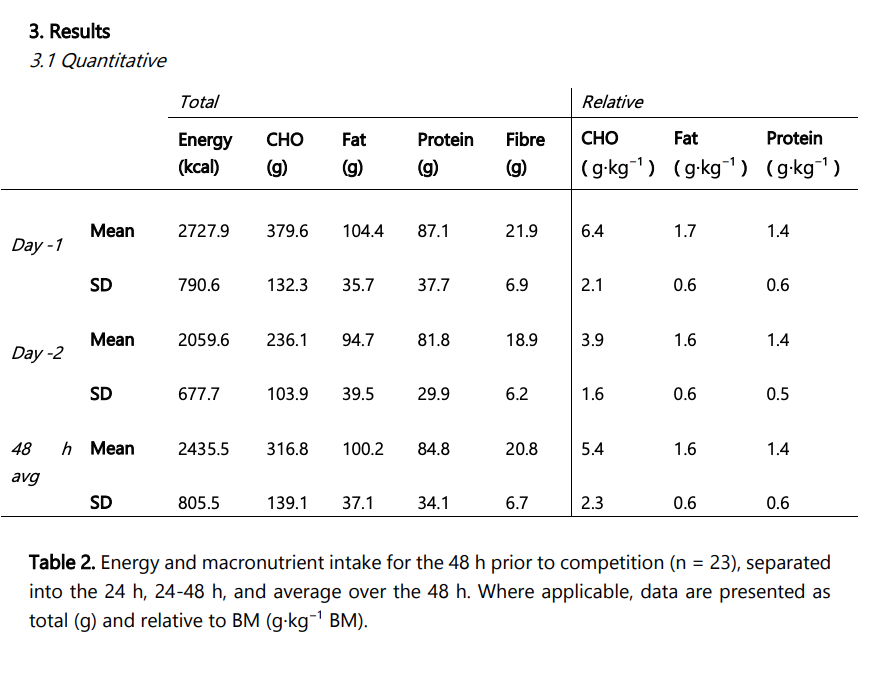
The recommended carbohydrate intake for the 24 to 48 hours before an endurance event of this length sits between 8 and 12 grams per kilogram of body mass per day. Among the 23 athletes whose food diary data was complete, mean intake averaged 6.4 grams per kilogram on the day before the race, rising from 3.9 grams per kilogram two days out. The range across individuals was wide, from 2.8 to 9.9 grams per kilogram, which tells you something important: Some athletes executed well. Most did not.
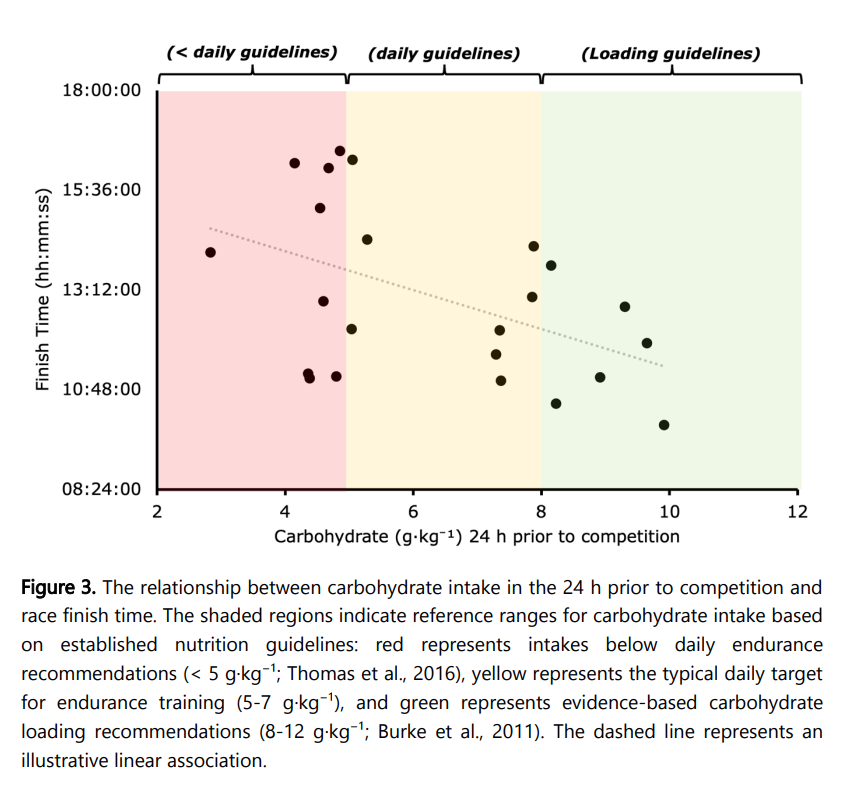
Higher carbohydrate intake in the 24 hours before the race was associated with faster finishing times, a moderate but statistically meaningful inverse correlation. This finding should be interpreted carefully. The athlete capable of executing their pre-race plan may have a similar execution in other areas benefitting performance: training preparation, pacing strategy, and racing experience, but the association is consistent with what exercise physiology has long indicated. Greater carbohydrate availability supports glycogen storage, sustains energy output, and delays fatigue over long efforts.
On the fiber side, the findings were equally clear. Pre-race fiber intake was strongly associated with gastrointestinal symptom severity during the race. Athletes who consumed more fiber in the 24 hours before competition reported greater digestive discomfort during the race. This matters because fiber reduction is a well-established tactic for pre-race preparation, yet several athletes in the study consumed fiber levels above the general population guideline of 30 grams per day, at a time when sport-specific guidance explicitly recommends reducing it.
The Intention Gap
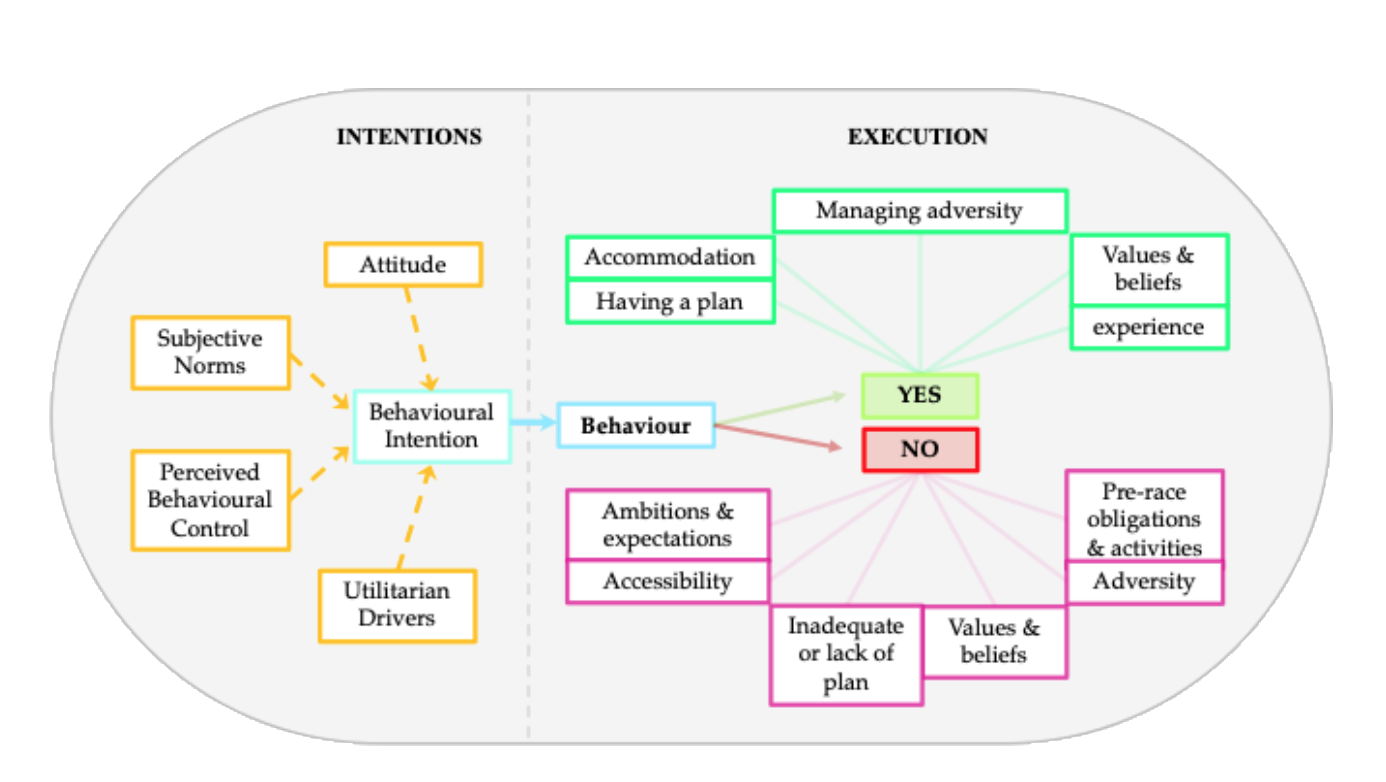
Why is there an execution gap? The study applied what the researchers called an Extended Theory of Planned Behavior (ETPB) framework, which helped them categorize the factors that either supported or disrupted nutritional execution. What they found was that athletes generally understood what they were supposed to do. Many could articulate specific carbohydrate loading targets. The problem was not awareness. It was the translation of awareness into action under real-world conditions.
Several distinct categories of disruption emerged. Logistical challenges were consistently cited. Race week is rarely a calm, or completely controlled environment. Athletes described travel delays, meals out at restaurants, unfamiliar food options, and social obligations that pulled them away from their planned routines. One participant, who managed only 5.1 grams of carbohydrate per kilogram on the day before the race, noted that she was on her feet for much of the day, felt rushed, and ended up grabbing whatever food items were available from local shops. This meant bars, pastries, and drinks, rather than following any structured nutrition plan. She hadn't stopped caring about nutrition. She had simply run out of bandwidth to manage it.
In contrast, athletes who described greater adherence also described greater control over their environment. Several specifically mentioned choosing accommodation with a kitchen, buying their own food, and avoiding restaurants in the days leading up to the race. One athlete, who achieved 9.9 grams per kilogram described following a routine that had become so established that it was almost automatic. She had packed the food she needed in her suitcase before she traveled.
Gut comfort was another key driver. Many athletes made food choices during the pre-race period not based on carbohydrate content but on how they expected their digestive system to respond. GI distress during a long-distance event is genuinely performance-limiting and deeply unpleasant. But the practical consequence was that some athletes avoided high-carbohydrate foods because they feared fullness or discomfort, and continued eating foods they associated with being healthy, and chose options like salads, vegetables, and whole grains without recognizing the fiber amounts those foods carried.
This reflects a broader tension: Public health messaging promotes high-fiber diets. For most people in most contexts, that guidance is appropriate. But in the 24 to 48 hours before an endurance event, the performance-specific recommendation is the opposite. Athletes without explicit education on this distinction may default to their habitual understanding of what constitutes good eating, which can work against them pre-race.
Emotional and psychological factors also played a role in execution. Pre-race anxiety, disrupted sleep, and the general pressure of the competition environment affected appetite and eating behavior. Some athletes described losing their appetite under stress. Others described the cognitive load of managing registration, logistics, equipment checks, and social commitments, and felt they had little mental space for nutrition planning.
The Competer-Completer Divide
The athletes' motivational perspective shaped their approach to pre-race nutrition. The researchers described a continuum from what they termed competers, athletes focused on time or placing, to completers, those athletes whose primary goal was finishing or enjoying the experience.
Competers tended to approach pre-race nutrition with precision. They followed structured plans, sought professional guidance, and viewed nutrition as a performance tool. Completers tended to take a more intuitive approach. Several explicitly described rejecting the need for detailed planning on the grounds that they were not competing for time or position. One participant stated simply that she was not fast and therefore did not need as much carbohydrate..
The physiological motivation is interesting. Notably, the distance and duration of an event, not the pace, drives energy expenditure. A slower athlete spending more time on the course does, in fact, need the carbs and calories just as much as the faster athlete. The identity-based logic may be working against the completer’s stated goal of having a good experience.
The researchers are careful to note that neither mindset is inherently right or wrong. Both represent legitimate ways of engaging with endurance sport. But the data suggest that athletes across the entire motivational spectrum could benefit from clearer, more personalized guidance on why pre-race fueling applies to them specifically.
What Supports Better Execution
Athletes who reflected and learned from past races and experiences tended to perform better (hello, practicing your carb load!). The development of a reliable, tested routine reduced the cognitive burden of making food decisions under race-week pressure. Having a process means fewer decisions need to be made in the moment. Athletes who arrived at race week with a clear approach to their carbohydrate loading, including specific foods, quantities, and timing, were less vulnerable to disruption because their decisions had already been made. Rehearsing the pre-race nutrition strategy during training, rather than implementing it for the first time on race week, appeared to support both physical preparation and psychological confidence. Athletes who had practiced their nutrition approach knew how it felt, which foods worked for them, and how much they could comfortably consume. That knowledge cannot be acquired in the final 48 hours before a race.
Athletes who brought familiar foods with them, identified suitable food outlets in advance, or booked accommodation with a kitchen reported greater adherence. This may seem like a small detail, but race week is exactly the time when small logistical barriers have an outsized effect on behavior. Building flexibility into the plan also mattered. Athletes who had identified portable, accessible carbohydrate sources as contingency options were better placed to adapt when circumstances changed, which they routinely did.
.png)
Rounding It Out
The difficulty lies in doing what you know you should do, under the specific pressures of competition. Nutrition knowledge matters, but it is not sufficient. The environment, the logistics, the emotional load of race week, and the personal motivation through which athletes assess their performance shape what happens on race week.
If you've ever arrived at race week with a clear nutrition plan and still found yourself falling short of your targets, you're not. Most athletes at big races understand what carbohydrate loading is, intend to do it, and still don't hit the numbers. The barriers are logistical, emotional, and environmental. This is where Fuelin is built to help. Rather than leaving you to interpret population-level guidelines and figure out what they mean for your body, your training load, and your specific race goals, Fuelin gives you personalized numbers, not a general recommendation. Crucially, those targets can be rehearsed across your training block, so that by the time race week arrives, the approach is already familiar. You know how the foods feel, you know how much you can comfortably consume, and you've done it before. During race week, we help reduce the decisions you need to make when your mental load is already high. The gap between intention and execution is a real, and Fuelin helps athletes to close that gap
Thank you,
Megan
Reference:
Fortis et al, 2026. From Intention to Execution: Pre-Race Nutrition Behaviours, Influences, and Performance Outcomes in Female Endurance Athletes at the IRONMAN® WorldChampionships