
The ability to burn fat during exercise is important for endurance performance. Carbs are king when it comes to high intensity training, but carbohydrate stored in muscle and liver is limited, while fat stores are large even in lean athletes. For athletes taking on long distance events, greater fat oxidation can help spare glycogen during long sessions and races.
If carbs are available, the body will preferentially use them. Research has already shown ways to acutely manipulate peak fat oxidation. This can be done through fuel availability (i.e. low carbohydrate diets, ketogenic diets, and fasting) which increases the peak rate of fat oxidation during exercise. Whereas eating carbohydrates beforehand lowers peak fat oxidation. This makes sense given that carbs are the body’s preferred fuel source for moderate- to high-intensity activities.
In this recent study by Lange and colleagues, they set out to find out how muscle glycogen content affects three things. The first is peak fat oxidation (PFO), the highest rate of fat burning during exercise. The second is Fatmax, the exercise intensity at which that peak occurs. The third is mitochondrial coupling control and efficiency, meaning how efficiently the mitochondria in muscle turn fuel into energy (ATP). Note: This article gets into research study and design. For the quick notes, skip to “Practical Considerations for Athletes”
Key terms
Peak fat oxidation (PFO) is the highest rate of fat burning reached during a graded exercise test, measured in grams per minute. Fatmax is the intensity at which that peak occurs, expressed as a percentage of VO2peak. VO2peak is the highest rate of oxygen uptake a person can reach.
Mitochondria are the powerhouse of the cell (if you know, you know) and they use oxygen to convert fuel into ATP. Coupling describes how closely fuel use is tied to ATP production. When coupling is loose, more energy is lost as heat.
The phosphate to oxygen ratio (P/O ratio) is the number of ATP molecules produced per oxygen atom consumed. It reflects mitochondrial efficiency. The respiratory control ratio (RCR) compares oxygen use when mitochondria are actively making ATP with oxygen use when they are idle. A higher RCR indicates tighter control and less wasted respiration.
Study Design
Ten healthy, trained men took part. Using a randomized crossover design, each participant completed both conditions in random order, 7 to 14 days apart. Each condition lasted two days. On day 1, after an overnight fast, participants gave a blood sample and a thigh muscle biopsy, then completed a graded cycling test to measure peak fat oxidation and Fatmax. They then performed a 2.5 to 3 hour cycling protocol, including high-intensity intervals and a ride to exhaustion, designed to deplete muscle glycogen. For the rest of the day, they ate either a high or a low carbohydrate diet. On day 2, after an overnight fast, they repeated the graded cycling test measuring peak fat oxidation and Fatmax.
Table 1 describes the two recovery diets. Each row is one diet. The columns give the average daily intake of carbohydrate, fat and protein, shown both in grams per day and as a percentage of total energy intake. Total energy intake did not differ significantly between the two diets.
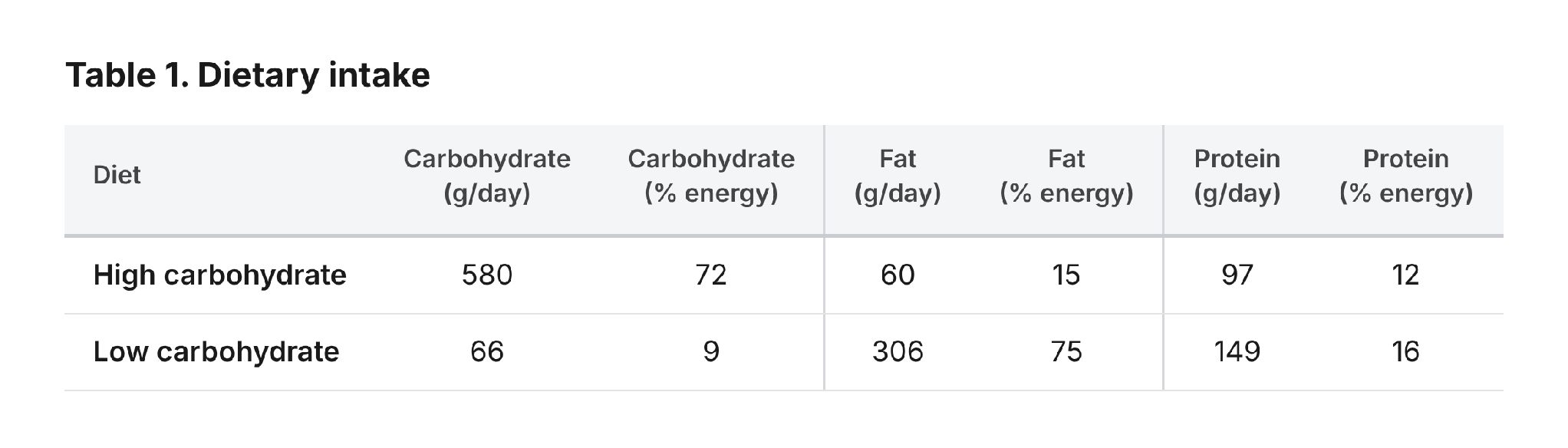
Expressed relative to body weight, carbohydrate intake was 7.4 grams per kilogram bodyweight on the high carbohydrate diet and 0.8 grams per kilogram bodyweight on the low carbohydrate diet.
Results: Glycogen, Fat Oxidation and Fatmax
Compared with baseline, resting muscle glycogen fell by 31 percent after the high carbohydrate day and by 69 percent after the low carbohydrate day. Table 2 shows the main outcomes. Day 1 values were collected before the depletion protocol and day 2 values the following morning. A single baseline glycogen value was used for day 1 of both conditions because only one baseline biopsy was analyzed. Change values are calculated from the reported means.
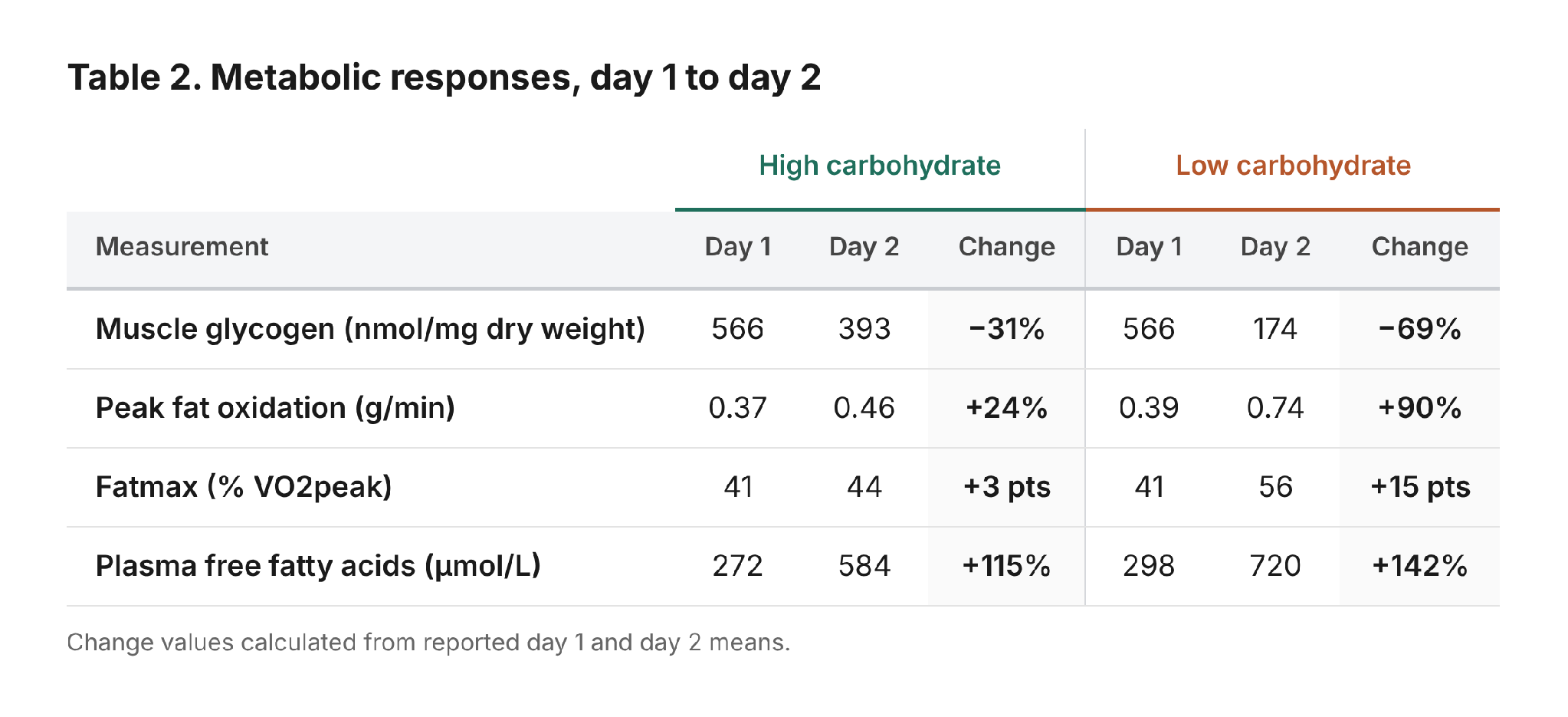
Peak fat oxidation rose by 24 percent after the high-carbohydrate condition and by 90 percent after the low-carbohydrate condition. Within individual participants, lower glycogen was strongly associated with higher peak fat oxidation. Fatmax shifted only in the low-carbohydrate condition, from 41 to 56 percent of VO2peak, meaning fat oxidation peaked at a higher exercise intensity.
Resting free fatty acids more than doubled on the second day in both conditions and were strongly associated with peak fat oxidation. The authors concluded that fatty acid supply was likely the main driver, and that glycogen alone could not explain the changes, since glucose, insulin, triglycerides, and ketones also differed between conditions.
Results: Mitochondrial Coupling and Efficiency
Mitochondrial coupling and efficiency did not change. Mitochondria isolated from each biopsy were tested with both carbohydrate-derived and fat-derived fuels. The P/O ratio stayed at roughly 2.3 ATP molecules per oxygen atom, and the RCR at roughly 20, at baseline, after the high carbohydrate day and after the low carbohydrate day. Neither measure differed significantly between conditions.
The authors noted two observations that did not reach significance: a slightly higher fat-fuelled P/O ratio after the high-carbohydrate condition, and a trend toward higher fat-fuelled maximal respiration after the low-carbohydrate condition. Both would need confirmation in larger studies It was concluded that the increase in fat oxidation was driven by the availability of fuel to the muscle and by the regulatory processes upstream of the mitochondria, rather than by a change in the efficiency of the mitochondria themselves.
Results: Performance and Blood Markers
The increase in fat oxidation was accompanied by lower maximal power and higher perceived effort, particularly after the low carbohydrate day. Table 3 compares day 1 and day 2 values in each condition. Each row is one measurement, with day 1 and day 2 values for each condition and the change between days. Maximal power is the highest output in watts during the maximal test. Perceived effort was rated on the Borg scale of 6 to 20 during the fat oxidation test. The respiratory exchange ratio, or RER, compares carbon dioxide exhaled with oxygen consumed. Values near or above 1.0 indicate heavy reliance on carbohydrates.
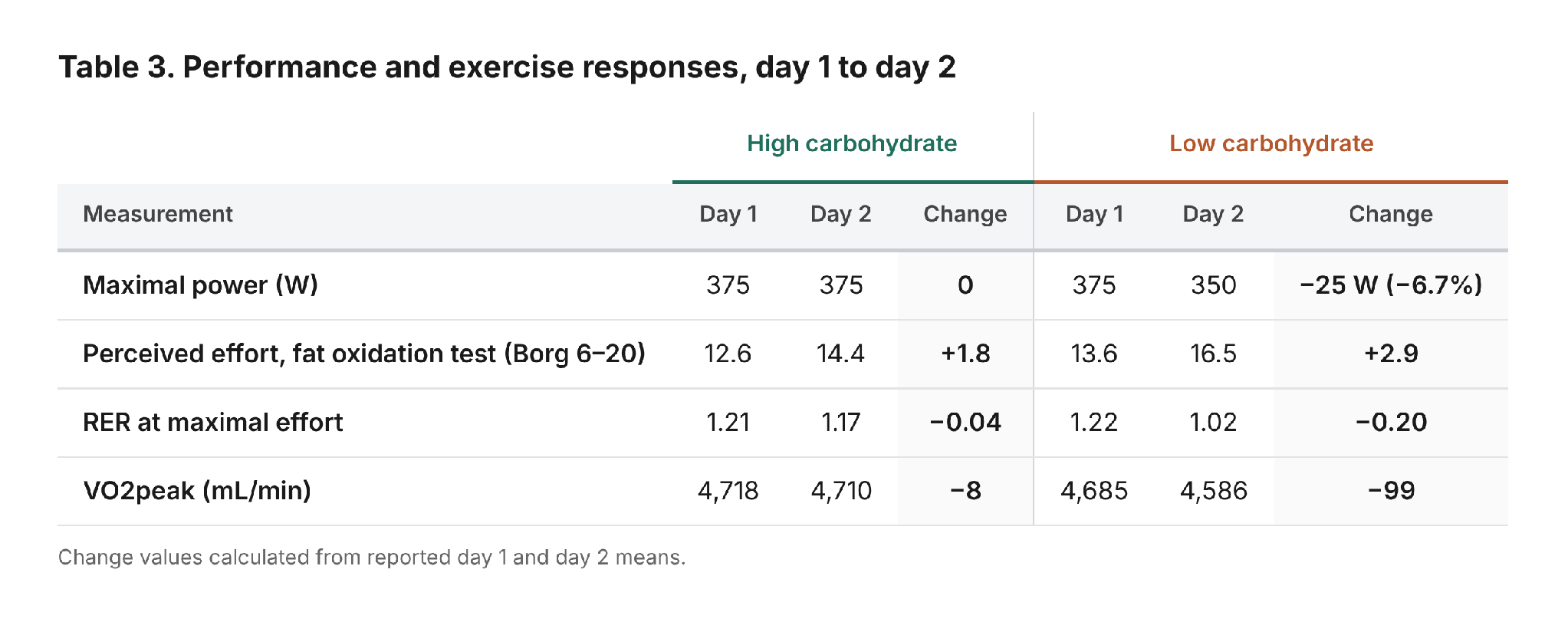
Maximal power fell by 7 percent after the low carbohydrate day only, and perceived effort rose more in that condition. VO2peak did not change significantly. The low RER at maximal effort shows that muscles relied on fat unusually heavily even near exhaustion.
Limitations
Several limitations affect how far the findings can be applied. The crossover design is a strength, however the intervention lasted one day, so it does not address any chronic adaptation to low carbohydrate or ketogenic diets over weeks or months. The sample was small and included only young trained men, so modest mitochondrial changes may have been missed.
Glycogen was also not the only changing variable. The diets altered blood glucose, insulin, fats and ketones, and the low-carbohydrate diet contained more protein. Day 2 testing followed the exhausting 2.5-3 hour session on day one, so fatigue may explain part of the reduced power. Blood was sampled only at rest, mitochondria were tested outside the muscle, and no race performance was measured.
Practical Considerations for Athletes
Fat oxidation is strongly influenced by short-term diet. In this study, peak fat oxidation nearly doubled after the low carbohydrate day while mitochondrial efficiency and VO2peak stayed the same. Importantly, peak fat oxidation does not directly equate to improved fitness. Athletes who track fat oxidation through metabolic testing may get more meaningful comparisons by standardizing diet and training in the 24 to 48 hours before each test.
Low carbohydrate availability was associated with lower maximal power and higher perceived effort. Because efforts at or above threshold rely heavily on glycogen, starting hard sessions or races with low glycogen may limit performance.
A single low-carb day did not make mitochondria more efficient. Improvements in mitochondrial capacity are generally attributed to consistent training over time.
These findings are relevant to approaches of carbohydrate periodization, in which intake is matched to the demands of each session, with more carbohydrate around hard training and less around lighter training. The study did not test whether this approach improves performance, but it shows how important daily carbohydrate availability is to fuel utilization.
It also shows that muscle glycogen recovery takes time. Even 7.4 grams of carbohydrate per kilogram of body weight did not fully restore glycogen within a day, consistent with guidance that at least 24 hours of high carbohydrate intake is often needed after heavy depletion.
Previous research established that low-carbohydrate diets and fasting raise fat oxidation, that carbohydrate lowers fat oxidation, and that circulating free fatty acid levels track closely with fat oxidation. This study adds two new findings. First, by measuring muscle glycogen directly, it showed that lower glycogen is closely linked to higher peak fat oxidation within the same athletes, and that combining glycogen depletion with a low carbohydrate diet also shifts Fatmax to a higher intensity. Second, it provided the first direct test in humans of whether glycogen availability alters mitochondrial coupling and efficiency, and found that it does not. The increase in fat oxidation appears to reflect changes in fuel supply rather than changes in mitochondrial function, and it was accompanied by reduced maximal power.
At Fuelin, we are passionate about helping athletes fuel well for the training they do. Research like this study is central to how we build our program, and we believe athletes train and race better when they understand the reasons behind their fueling plan, not only the numbers.
Fuelin uses each athlete's anthropometrics, training data and weight goals to determine their nutrition needs. Those targets are then periodized across the week, with more energy and carbohydrate around the hardest training days and less on lighter days. This study illustrates why that matters. Carbohydrate availability shapes how the body fuels exercise from one day to the next, and low glycogen can limit the high-intensity work that hard sessions and races demand. We will continue to review new nutrition research and explain what it means in practical terms, so that athletes can make informed decisions about how they fuel.
Reference
Lange KK, Becker L, Rømer T, Hassing M, Høybye ST, Smailes N, Pardo P, Danisman B, Andersen PF, Larsen S, Helge JW. Effects of exercise followed by a low carbohydrate diet on peak fat oxidation and mitochondrial coupling control and efficiency in healthy trained men. The Journal of Physiology, 2026. doi:10.1113/JP291697