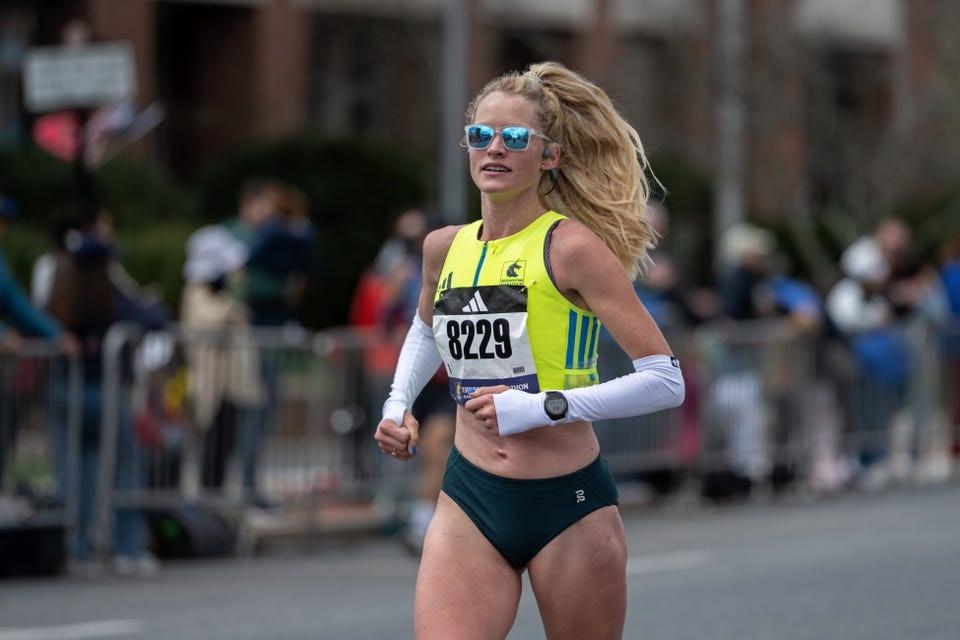
Gabriella Smith ran a 2:58 marathon in Chicago six months postpartum. Twenty-five minutes after crossing the finish line, she was in an emergency room. She couldn't keep food or fluid down. She couldn't hold her baby up to feed her. She was losing consciousness.
She'd hit a sub-three. She missed the entire post-race: the celebration, the Metal Monday, the city. She skipped all of it because something her body had been quietly trying to tell her for sixteen weeks finally caught up in one afternoon.
"I literally could have died," she told us on Fuelin Sessions. "And it's just, sometimes nutrition and anything that's a routine, that has to be a commitment every single day, it can be a little bit daunting."
That's the part most athletes never say out loud.
The mother of two who trains 11 hours a week
Gabriella is chasing the Abbott Six Star. Chicago and Boston are done. Berlin is next, in September, with London, Tokyo, and New York to follow. She'd like to finish on home soil in New York, and she wouldn't mind running a 2:37 in Berlin on the way there.
She does this on three run days a week and three cross-training days on the Peloton, peaking around 65 miles, with two kids under four and two jobs. She built her own training plan. She is, in her own words, uncoached and self-aware about what she can and can't do well.
What she didn't do well, for years, was eat.
"I wasn't fuelling. I was guessing."
Before Fuelin, her relationship with food during marathon builds was, by her own admission, a mess of skipped lunches, kids' leftovers, and grab-and-go pantry decisions. Not because she didn't care. Because she was running a household on no sleep while breastfeeding while training for majors.
The pattern she only saw later: chronic under-eating on protein, chronic under-eating on carbs, and a relentless sweet craving at 9pm that she'd always written off as a personality trait.
"My husband jokes that I have such a sweet tooth," she said. "I don't actually think that's what it is. I think I was so under-fuelled that my body at 9pm was telling me, you need carbs, because you're so under, and I know you're going to wake me up at 6am and have me do a 10-plus mile workout."
Four weeks into Fuelin, the nighttime sweet cravings have largely gone. She hasn't done anything dramatic. She's just hit her targets during the day.
What four weeks of tracking actually changed
This isn't a transformation story. It's an awareness story, and that's the more useful one.
What Gabriella has learned in four weeks isn't that she needs to eat differently. It's that she needs to eat more, and more deliberately, and that the version of "eating clean" she'd been holding herself to was quietly a euphemism for under-eating.
Two specific shifts she called out:
Lunch isn't optional. Her biggest fuelling gap was the middle of the day, when work is loudest and her appetite is quietest. Fuelin's smart adjustments push the missed macros into later meals, and that math gets ugly fast. 70g of protein on top of dinner is not a realistic ask. The app made the cost of skipping lunch visible in a way a vague guilty feeling never did.
"Eating clean" was a trap. She'd internalised a binary: if she couldn't eat well, it was better not to eat. That logic is how serious athletes end up chronically under-fuelled while believing they're being disciplined. "Sometimes it's better to get the fuel, no matter what the source is, than to skip it and then be under-fuelled for my next workout."
That's the sentence we'd put on a wall.
The honest version of the pitch
Gabriella's been on Fuelin for four weeks. Berlin is months away. There's no PR yet, no medal photo, no before-and-after. What there is, is a smart, fast marathoner who spent two years guessing, and who now isn't.
If you've been telling yourself that your nutrition is "probably fine," it's worth asking the harder question Gabriella asked: how would I actually know?
Scott