Two weeks after the Bondi to Manly Ultra, my legs are finally talking to me again, so it's time to look at the numbers.
First, the only two that actually mattered.
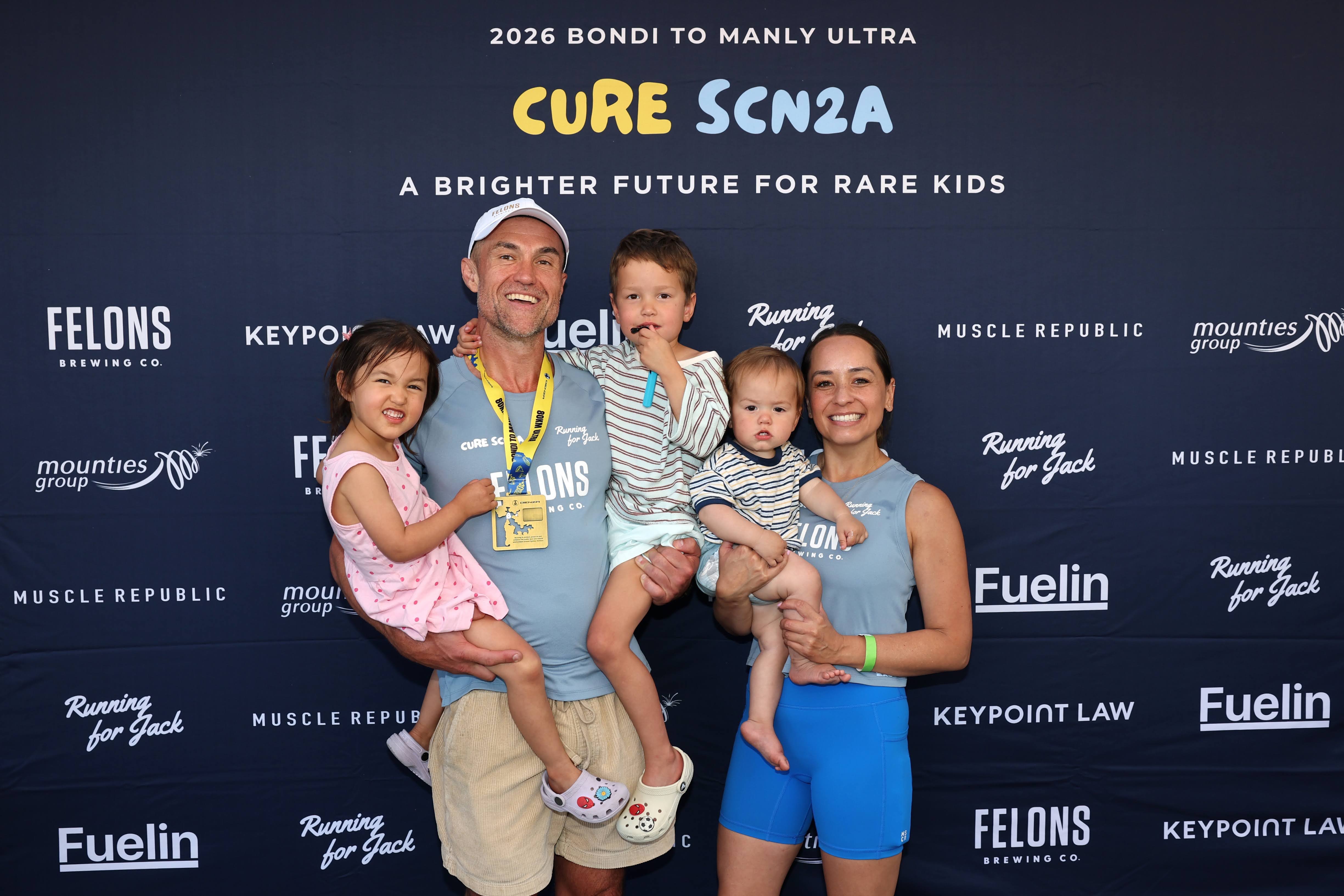
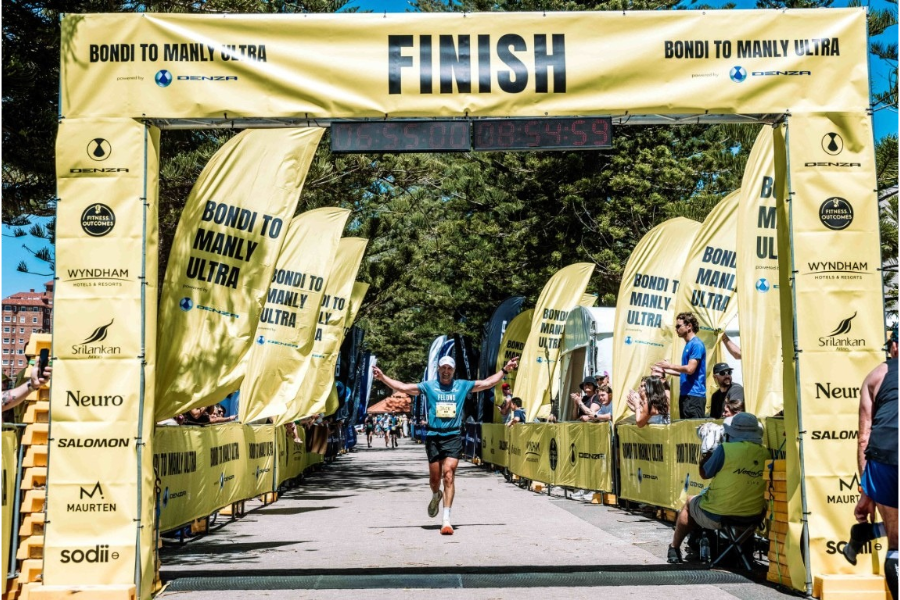
Priority one was raising money for Jack, and we pulled in over $365,000. Priority two was getting to the finish. The goal was 9 hours and I came across in 8:45. I easily left half an hour out there chatting to Mel at the checkpoints, hugging Jack, and saying g'day to my parents, but the whole point was to enjoy the day. I have absolutely no problem with this as a finishing time was not the goal.
[NOTE: at one point there was a slght panic that I might finish 9:01hrs and that was too hard to fathom given the recentt marathon times!]
As far as execution goes, that was about as good as any race I've ever had. A lot of that is down to the prep, and some of it is just the reality of ultra pace & and check points. Here is how we put the plan together, what actually went in, and what my sweat data said at the end.
Where the plan came from
None of this was thrown together the week before. Every session in the build was fuelled in Fuelin, so the routine was locked in long before race day. I tracked sweat rates and ran carb capacity tests in Fuelin to figure out my fluid needs and gut tolerance at these slower paces, and I built the race plan off that. Purple Patch Fitness handled the pacing through TrainingPeaks, and Precision Fuel & Hydration supplied the product.The plan as simple.
It sounds boring, but failing to plan is planning to fail. Consistency in training, fuelling, and hydration is what carried the day. I had a smile on my face for most of the 80 km (the last 10 hurt) because I knew the plan was built on my actual numbers, my training, and what I could realistically handle. Having Jack at the check points and at the finish line certainly made the day easier as well. Not going to lie, there were some tears along the way.
The plan
One of the massive upsides of an ultra is that you can lay everything out beforehand. I packed and labelled bags for the start and for each of the three checkpoints, so I knew exactly what I was carrying, what I'd eaten, and what was waiting up the road.
The course breaks into four legs: Bondi to Rose Bay (CP1) at 18 km, Rose Bay to Milson's Point (CP2) at 40 km, Milson's Point to Clontarf Beach (CP3) at 62 km, and then home to Manly. I was self sufficient to CP1 and to CP2. It was 0630 in the morning and I was not expecting Mel and the kids to come over to the other side of Sydney to see me. Mel, Nick (mate), Mum and Dad met me at CP2 and CP3 with a fresh bladder, gels, an ice cold Coke, and water (see below plan).
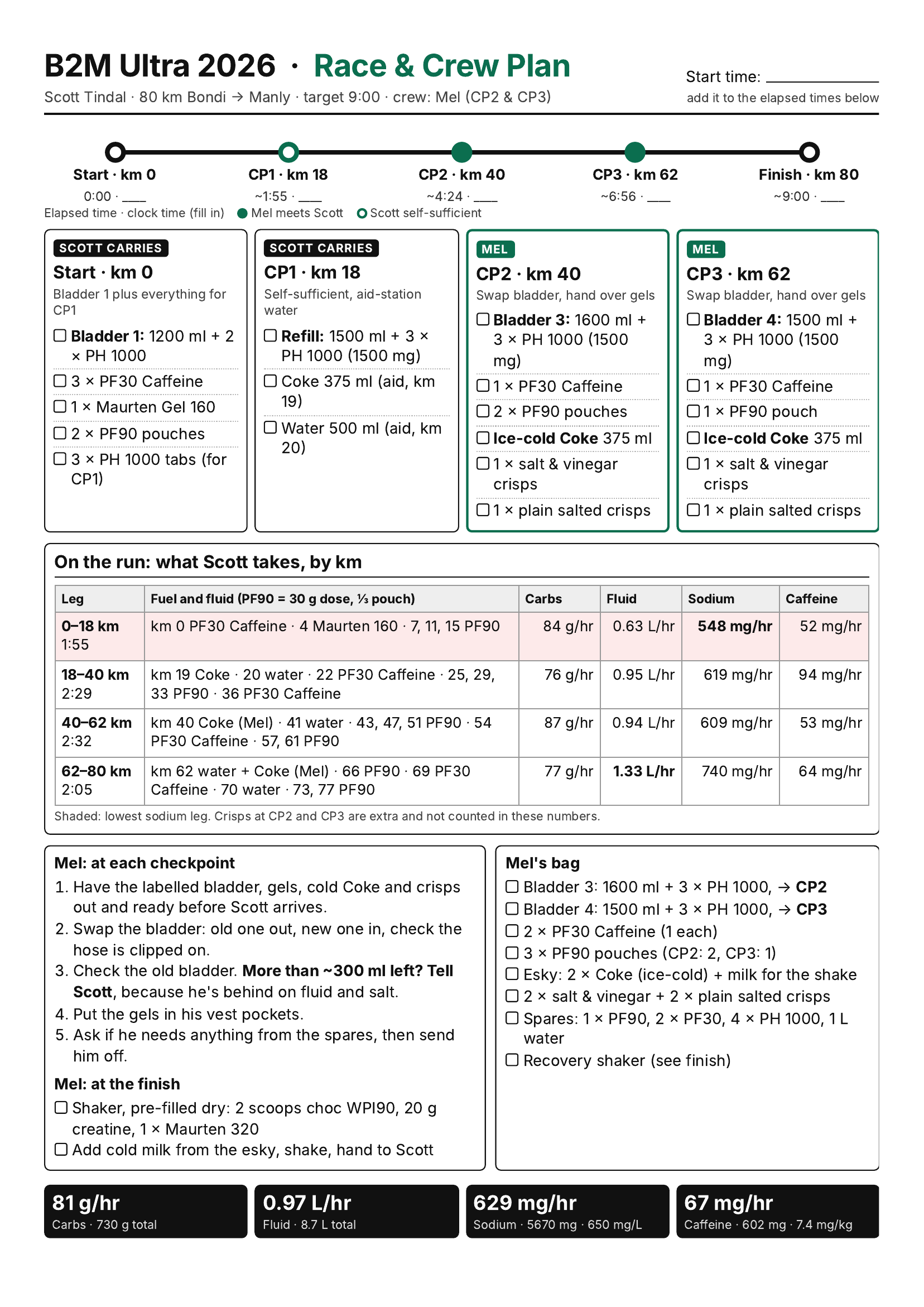
The targets for the day:
Carbs: 81 g/hr (730 g total carbs)
Fluid: 0.97 L/hr (8.7 L total fluid)
Sodium: 629 mg/hr (5,670 mg total sodium, 650 mg/L)
Caffeine: 602 mg (7.4 mg/kg)
Precision Fuel & Hydration did most of the work: PF90 pouches split into 30 g doses (a third of a pouch every feed), PF30 Caffeine gels, and PH 1000 tabs in the bladders (two in the first 1.2 L bladder and three in each one after that). It was pretty much caffeine gel at 15 mins, 1/3 PF90 gel at 30 and 45 mins. PF&H also supplied product to all 105 runners on the day, which was huge. A huge thank you to Andy and his team for doing that and being a supporter of our charity, Cure SCN2A. I added two Maurten gels just because they were on course and I wanted the extra carbs.
What actually went in
Carbs: Completed 88 g/hr / 730 g total
(Planned 81 g/hr / 770 g total)
I finished 7 g/hr over plan, 88g/hr [770 g total]. I was right on target for the first two legs, then 11% and 13% over in the last two thanks to an extra PF90 at km 59 and a Maurten 100 at km 75. I was feeling great and know that I tend to feel better with higher carb intake.
The main takeaway here is zero upper or lower GI issues. Not one. After years of telling athletes to train their gut, it's good when your own advice and system actually shows up on race day.
Fluid: Completed 0.83 L/hr / 7.29L
(Planned 0.97 L/hr / 8.73 L)
This is where things drifted a little yet for the best. I drank 7.29 L against a plan of 8.73 L, so 1.44 L less across 8 hours and 45 minutes. The Coke cans I had planned ended up being bottles - 330 ml, not 375 ml. Not a huge drop yet it all adds up. The reality was, it was cooler on the day than I thought it would be. Especially for legs 1 & 2. I did drink the amounts I planned for these leghs and the reality is that it was probably a bit too much and in essence I front loaded fluids.
The last bladder came across the finish line with 800 ml still in it. This was a mistake as effectively I carried close to 1 kg on my back during the last 18km. That plan asked me to drink 1.33 L/hr on the leg where I probably didnt need it. That's a planning error as much as an execution one.
Sodium: Completed 562 mg/hr/675 mg/L
(Planned 629 mg/hr/650 mg/L)
Total intake was 4,920 mg against 5,670 mg planned. Most of my sodium was in the bladders, so when fluid dropped, sodium dropped with it. That's the trade off when you rely on your drinks for salt. The interesting bit is that because fluid and sodium dropped together, the actual concentration of what I took in went up slightly to 675 mg/L against the 650 mg/L I'd planned.
Caffeine: Completed 502 mg /6.2mg/kg / 67 mg/hr
(Planned 602 mg/ 7.4 mg/kg / 57 mg/hr)
That works out to 6.2 mg/kg instead of 7.4 mg/kg, or roughly 57 mg/hr across the race against 67 mg/hr planned. The reason is simple: I stuffed up. At km 22 I grabbed a plain PF30 instead of a caffeinated one, and there goes 100 mg. Labelled bags only work if you actually read the labels and pack the right products.
Before anyone jumps in the comments: yes, that total sits above the 3 to 6 mg/kg range you always see quoted. That guideline is for a single dose before or early in exercise, not a hard cap for an entire day. Over nearly nine hours, what matters is the rate. Spread out, 502 mg is roughly 0.7 mg/kg per hour, just topping up as the earlier doses wear off rather than taking one massive hit.
I drink a lot of coffee and am caffeine tolerant. This is not for everyone and I would advise listening to these epsiodes on caffeine with Dr Lindsey Hunt and Megan Foley RD.
I will also say, I was buzzing at the end and manged to party til 2130 at night with the family and all the runners at Felons Brewery (title sponsor for Cure SCN2A). I think the caffeine intake had somethign to do with that as well!!
What came out: the FLOW BIO data
I wore a FLOW BIO hydration sensor for the whole race. I had been playing around with this sensor in training and was interested to see what data it produced.
Estimated Sweat loss: 8.3 L
Estimated Sweat rate: 0.94 L/hr
Estimated Non sweat losses: 1.3 L (around 9.6 L all up)
Estimated Sweat sodium: 1,007 mg/L
Estimated Total sodium lost: 8,357 mg
Fluid balance
I drank 7.29 L against 8.3 L of sweat. That's 88% replaced. The bit that made me pause: my planned intake of 8.73 L was actually more than I sweated. If I'd drunk to exactly my fluid plan to the millilitre, I would have finished the day with more fluid in than out. Now, I do not know how accurate the estimated fluid loss was because testing in training often showed the estimated sweat loss and sweat rate was lower than what actually happened when comparing the sensor data to simply weighing myself on a scale before and after the session and entering it into Fuelin. Nonetheless, it is a good awareness piece to still listen to your body and level of thurst as a marker for fluid intake as well.
Sodium balance
At around 1,000 mg/L from the FLOW BIO data, I'm a reasonably salty sweater. I took in 675 mg/L, which is about 67% of my estimated sweat sodium concentration, and 4,920 mg of the 8,357 mg I lost, or 59% of total losses. You don't need to replace 100% of sodium losses during a race as Dr Alan McCubbin and I have discussed on many of our Fuelin Sessions podcasts. I did however consume well over 70% of the estimated fluid loss. So, given this and the duration of the race, consumption of sodium makes sense. Could I have consumed more - maybe? Did I need to? I don't believe so. Performance wise I had no issues.
I did get close to hamstring cramps near the end, which I put down to muscle fatigue rather than sodium or fluid balance. As we've covered on plenty of Fuelin Sessions episodes, the link between sodium and cramping is a lot shakier than the internet makes out. Eighty kilometres of stairs and sand will do that to anyone's hamstrings in my opinion. Certainly me!
What I'd change next time
Not much to be honest. Maybe a planned higher carb intake rate of around 90g/hr. Fluid intake maybe could have been further planned by looking at temperatures expected on the day and planning even harder for the cooler and hotter parts of the day. My pacing was on point - I did not run one stair or one hill - if I race this race again, I may push the pace a little harder and attempt to run some of these.
It takes a village
The other old saying that holds up: it takes a village.
Fuelin, Purple Patch Fitness, TrainingPeaks, and Precision Fuel & Hydration all played their part, and everyone showed up for me, for Mel, and most importantly, for Jack. For these companies, I am so grateful.
I've attached the full planned vs actual breakdown so you can see how it played out leg by leg. If you've got questions or comments, drop them below.

And if you've done an ultra and had a similar experience, or nothing like it, let me know how it went.
Scott