Caffeine is one of the most popular, and tastiest performance-enhancing substances. Most athletes know it can help during sessions or races, with doses of about 3 to 6 mg per kilogram of body mass showing the most efficacy. But a different question has come up more often: can caffeine help athletes recover after a hard session?
Recovery is not just one thing. Soreness, fatigue, strength, muscle damage, and sleep each have their own recovery timelines, and how an athlete feels doesn't always match what is happening physiologically. A new systematic review by Zhang et. al. looks at caffeine's effects on aspects of recovery. The authors examined 17 studies with 268 participants in total, and 16 of those studies provided enough data to be combined.
Notably, most participants were young, trained men, although several studies included women. The exercise ranged from eccentric and resistance work to running, cycling, repeated sprints, football, and judo. Caffeine was usually taken as a capsule or tablet at 3 to 6 mg per kilogram, typically 30 to 60 minutes before exercise or before a recovery test.
Four areas of recovery were considered. Perceptual recovery: which covered soreness, pain, and perceived fatigue or recovery. Functional recovery: which looked at strength, jumping, sprinting, and endurance measured in the hours and days after exercise. Physiological recovery: which included blood markers of muscle damage such as creatine kinase, and sleep recovery: which covered sleep onset, how long and how efficiently athletes slept, and how rested they felt.
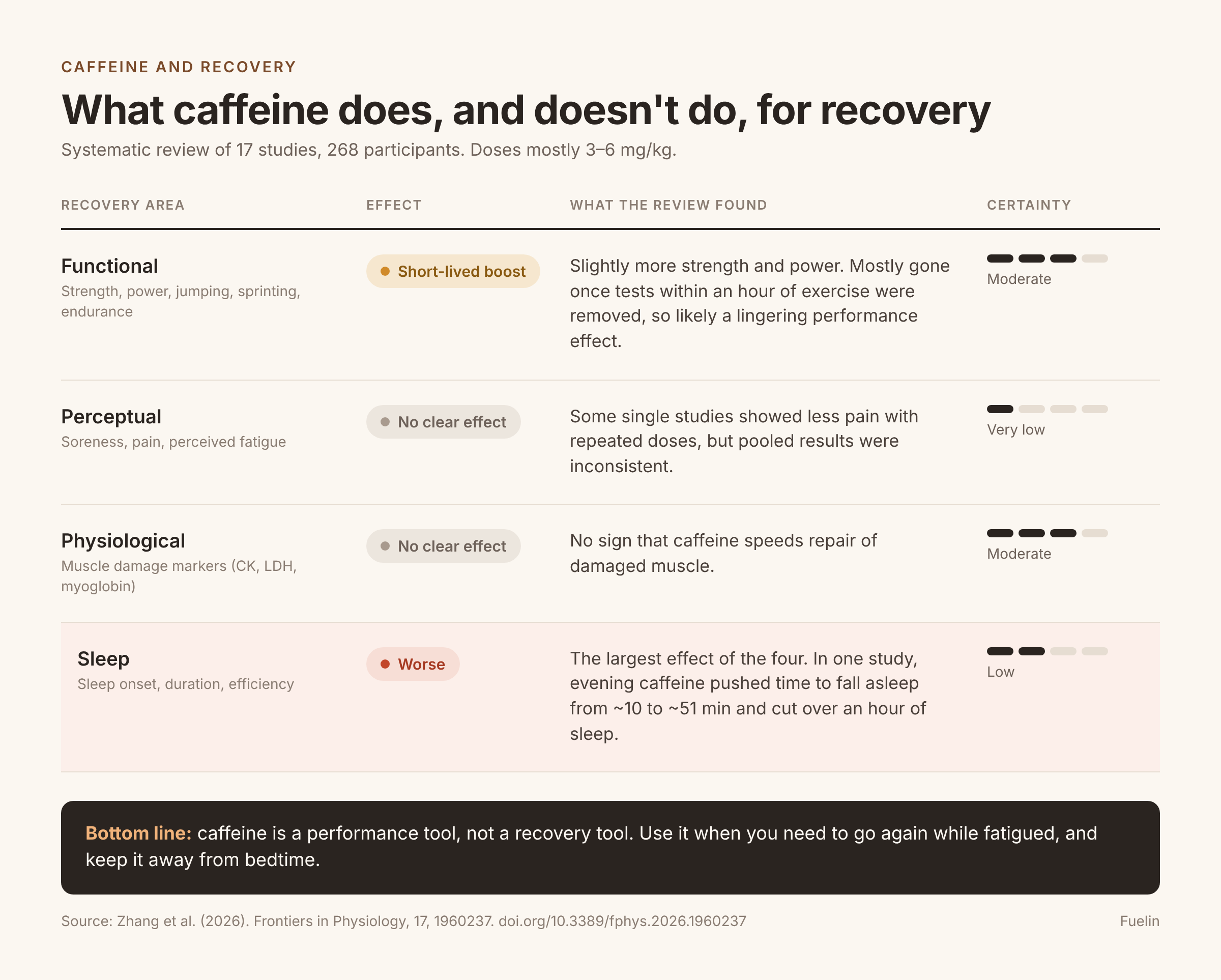
The primary finding is that caffeine is not an all-encompassing recovery tool. Its effects depended on which part of recovery was measured, and the differences between the four areas were statistically significant.
Functional Performance
For functional performance, caffeine produced a small benefit. Athletes tended to produce slightly more strength and power during the recovery period with caffeine versus than without it. However, when the researchers removed tests done within an hour of exercise, the benefit decreased and was no longer statistically significant. This suggests much of it may reflect caffeine's usual performance benefit lingering rather than faster recovery.
Soreness
For soreness and perceived fatigue, caffeine made no clear difference. Some individual studies found less pain, particularly when caffeine was taken repeatedly in the days after exercise that damaged muscle, but the pooled results were inconsistent, and the certainty of this evidence was rated very low.
Physiological
For blood markers of muscle damage, caffeine also made no clear difference. Creatine kinase, lactate dehydrogenase, myoglobin, and markers of oxidative stress did not improve, so there is no sign that caffeine speeds up the repair of damaged muscle tissue.
Sleep
Sleep was the one area where caffeine clearly made an impact, and the impact was negative. Across four studies, caffeine was linked to worse sleep after exercise, and this was the largest effect of the four areas of recovery. In one included study, 6 mg per kilogram of caffeine taken in the evening improved cycling time trial performance but significantly increased time to fall asleep from about 10 minutes to about 51 minutes and cut total sleep by over an hour.
The researchers also looked at the dose, timing, recovery window, and type of exercise changed the results. None of them clearly did. However, most studies used 3 to 6 mg per kilogram, so less is known about lower or higher doses. Habitual caffeine intake was reported too inconsistently to test, even though regular coffee drinkers may respond differently from people who rarely use caffeine.
The authors note cautions when interpreting their findings. Only four studies with 40 participants contributed to sleep data; none of the included studies were rated as having a low risk of bias, and the functional and sleep results lost or gained statistical significance in some robustness checks. Overall, certainty of evidence was moderate for functional and physiological recovery, low for sleep, and very low for soreness and fatigue.
For Athletes
The practical message is, as always, moderation. Caffeine may help athletes maintain performance when they have to go again while still tired or sore, such as a second session in a day or in multi-day events. It does not appear to repair muscle or reduce soreness, and when taken in the late afternoon or evening, it can cost athletes sleep, which is one of the most powerful recovery tools available. If athletes train or compete late in the day, consider the dose, how close it is to bedtime, an individual’s sensitivity to caffeine, and what is planned for the next day.
Caffeine may be better understood as a performance tool than a recovery tool. It offers small benefits in strength and power when an athlete is operating under fatigue, but has little impact on soreness or muscle damage. Most importantly, it can undermine sleep when timed poorly in the afternoon. Overall evidence is still limited, but the picture is clear enough to guide smarter choices.
Recovery comes from nailing the fundamentals: enough total energy for the work you are doing, the right fuel around your hardest sessions, and quality sleep. This is where we will guide all of our Fuelin athletes first. Your recovery is supported by what is on your plate, not by a stimulant. We’re here to help athletes think through questions like whether caffeine use fits your schedule without costing sleep. Used thoughtfully, caffeine can still earn a place in your routine, but it works best in addition to a solid fueling plan.
Reference:
https://www.frontiersin.org/journals/physiology/articles/10.3389/fphys.2026.1960237/full