.png)
Endurance athletes spend a lot of time thinking about food and fueling. A new study suggests that, for those aiming for weight loss, how those calories are divided may affect hormonal function. The research published in the Journal of Applied Physiology by Nusser looked at whether carbohydrate intake, independent of total energy intake, changes how the body responds to a period of low energy availability. The findings offer intriguing evidence that energy availability and carbohydrate availability, while closely related, are not the same variable, and that changing one without changing the other can meaningfully affect hormone and metabolic outcomes in both men and women.
Why this study matters
Low energy availability (LEA) describes a state in which dietary energy intake is not enough to cover the body's basic functions once the energy cost of exercise is subtracted. It is the underlying driver of Relative Energy Deficiency in Sport (REDs), which carries negative consequences for health and performance. Carbohydrate availability is a related but distinct concept, defined as the difference between carbohydrate intake and the amount of carbohydrate oxidized during exercise.
Thus far in research, Low Energy Availability and Carbohydrate Availability have moved together. When researchers reduce a participant's energy intake while keeping the proportion of carbohydrate, protein, and fat fixed, carbohydrate intake necessarily drops along with total calories. That design makes it difficult to know whether the hormone and metabolic changes seen in these studies come from the energy deficit itself or from the accompanying drop in carbohydrate.
This study was built to separate those two variables. Researchers held energy availability constant at 25 kilocalories per kilogram of fat-free mass per day, a level below the 30 kilocalories per kilogram of fat-free mass per day that has previously been mentioned as a potential threshold for LEA.
Within the participant’s 25kcal/kg/day intake, they manipulated carbohydrate intake between a low and a high amount using fully controlled feeding and a standardized daily exercise session, so that both groups ended up with an identical calorie deficit but very different carbohydrate intakes. The authors aimed to isolate the specific contribution of carbohydrate availability during a state of energy deficit.
What the study found
Sixteen recreationally active adults, nine women and seven men, completed two four-day conditions, separated by at least two weeks of normal eating and training. In one condition, participants followed a low carbohydrate availability diet within the energy deficit, targeting about 1.5g of carbohydrate per kilogram of body weight per day. In the other, they followed a high carbohydrate availability diet within the same energy deficit, targeting about 4.0 grams of carbohydrate per kilogram per day, which is in line with general carbohydrate recommendations for endurance athletes. All food was weighed and provided by the research team, and daily exercise was standardized so that both conditions produced the same overall caloric deficit. Participants also completed a cycling ramp test at the beginning and end of each trial with power increasing slowly at the start, then rapidly once the participant's RER reached 1.0 or their rating of perceived exertion was 17 or higher on the 20-point scale. The test continued until participants reached volitional exhaustion.
The Results
Both conditions led to modest weight loss and to declines in several hormones commonly associated with low energy availability. This was expected given the subjects were in a calorie deficit. However, the two conditions differed in interesting ways.
In the low carbohydrate condition, IGF-1, a hormone that plays a central role in tissue growth, repair, and bone health, declined by roughly 20 percent from baseline. In the high carbohydrate condition, that decline was significantly less, closer to 9 percent.
Other hormones followed a similar pattern without reaching the same level of statistical certainty. Insulin, leptin, and testosterone all declined significantly from baseline in the low carbohydrate condition but did not decline significantly in the high carbohydrate condition. More study participants would have been needed to potentially show significance. The thyroid hormone, T3, did not change meaningfully in either condition, suggesting that for some markers, the size of the energy deficit itself matters more than how the carbohydrate is divided within it. The researchers also tracked how the body shifted its fuel use during the deficit. As expected, both conditions produced an increase in fat burning and a decrease in carbohydrate burning, both at rest and during exercise, along with a rise in the ketone body beta-hydroxybutyrate. Carbohydrate availability did not meaningfully change the size of this shift.
Athletes eating more carbohydrate during the deficit still moved toward burning more fat, much like those eating less carbohydrate did. What did differ was the body's ability to work at higher, more glycolysis-dependent intensities.
Blood lactate response, a marker of the body's capacity to produce energy through glycolysis, declined and shifted in the low carbohydrate condition but held steady in the high carbohydrate condition. This suggests that adequate carbohydrate intake helped preserve the ability to sustain harder efforts, even as the body's overall fuel preference tilted toward fat. This is an important takeaway for endurance athletes! Providing carbs enables athletes to work at higher intensities.
Maximal aerobic capacity and peak power output were unaffected by either condition. The authors note that the short, cycling ramp test used in this study may not be sensitive enough to detect the kind of performance decline that depends more heavily on depleted muscle glycogen, an effect that tends to show up over longer efforts or across repeated training days rather than in a brief maximal test. Participants completed a stepwise exercise test that began at 50 watts for women and 100 watts for men, with power output increasing in 25 watt increments every four minutes. Once the respiratory exchange ratio reached 1.0 or the participant's rating of perceived exertion reached 17 or higher on the 20 point RPE scale, the test transitioned immediately into a ramp phase, during which power output rose continuously at a rate of 25 watts per minute until the participant reached volitional exhaustion.
What this means for periods of energy deficit
This may be useful information for athletes who go through intentional periods of reduced energy intake, whether for a preseason body composition goal or an unintentional deficit created by a heavy training block. The amount of carbohydrate eaten during that deficit period appears to matter, separate from the size of the calorie deficit itself. Keeping carbohydrate intake relatively high during a deficit, even while total calories remain low, appears to partially protect hormone systems tied to tissue repair and recovery in the short term, and appears to help preserve the capacity to train at higher intensities without as sharp a shift away from glycolytic capacity.
This does not mean that high carbohydrate availability eliminates the physiological cost of an energy deficit.
Fat oxidation still increased and several hormones still declined in both conditions, underscoring that total energy availability remains the dominant driver of the body's response to a deficit, with carbohydrate acting as a secondary factor that can soften some, but not all, of the impact.
Sex differences
Sex, more than carbohydrate availability, explained many of the metabolic shifts observed in this study. Male participants showed a larger rise in fat oxidation and ketone production in response to the energy deficit regardless of carbohydrate intake, while females showed smaller shifts in fuel use that did not reach statistical significance. In men, the rise in the ketone body, beta-hydroxybutyrate, occurred in both the low and high carbohydrate conditions, suggesting carbohydrate intake did little to blunt this response.
In women, the same ketone rise was largely prevented under the high carbohydrate trial, suggesting a possible protective effect of carbohydrate on fuel metabolism in women compared with men.
More on the caveats of this later. The protective effect of higher carbohydrate intake on hormones also appeared more pronounced in women. Female participants in the high carbohydrate trial showed the smallest relative hormone declines of any group, with insulin falling by less than 1 percent and IGF-1 by only about 4 percent, compared with much larger declines under low carbohydrate availability. Leptin followed a similar pattern in women, declining by roughly half as much under high carbohydrate availability as under low carbohydrate availability. In men, leptin changes were more variable and did not reach statistical significance in either condition. These patterns suggest that maintaining higher carbohydrate intake during a period of energy deficit could potentially carry a larger hormonal benefit for women than for men. However, this is observational, not confirmational. A larger trial with more men and women is necessary to further study this before a conclusion may be reached.
The takeaway is not that men can safely ignore carbohydrate intake during a deficit. Both sexes showed better preservation of glycolytic capacity with higher carbohydrate availability. Rather, it suggests that female endurance athletes may want to pay particular attention to carbohydrate intake during any intentional or unintentional period of energy restriction, given the potentially larger hormonal cost observed when carbohydrate availability was low.
Caveats to keep in mind
This study is an important first step, but there are limitations. With only 16 participants completing the trial, the total subject group was small. Participants were recreationally active adults rather than highly trained endurance athletes, so it remains to be seen whether the same pattern would hold in athletes with years of endurance training, greater glycogen storage capacity, or substantially higher training volumes. Notably, the researchers note that the apparent sex difference may relate to body composition and fat-free mass rather than just sex.
Because the female participants in this study had less fat-free mass than the male participants, expressing carbohydrate availability relative to fat-free mass rather than total body weight increased women's carbohydrate targets above men's at the start of the intervention.
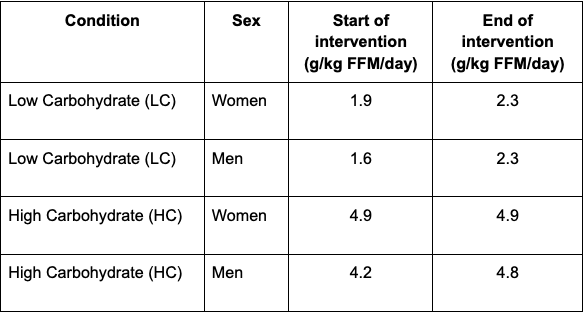
The intervention lasted only four days. This is useful for isolating short-term hormonal responses but cannot speak to what happens over the weeks or months of a training block or an intentional body composition phase.
The menstrual cycle phase was not controlled for in the female participants. However, the authors note that the hormonal changes observed were considerably larger than what would typically be expected from cycle-related fluctuation alone. The diet used in the study was predominantly vegetarian, and the timing of carbohydrate and energy intake across the day was not standardized, so questions about how meal timing interacts with carbohydrate availability during a deficit remain unanswered. Finally, because the shift toward fat oxidation over the four days changed how much carbohydrate participants actually had available relative to what they were burning, the gap between the low and high carbohydrate groups narrowed somewhat by the end of the trial, a reminder that carbohydrate availability is a moving target rather than a fixed number.
Given these limitations, this study is an important first look at carbohydrate needs during an energy deficit.
It offers evidence that energy availability and carbohydrate availability are separate variables worth tracking individually, and it lays the groundwork for future research in larger, more athletic populations, ideally over longer training blocks, and with reproductive hormone markers included for female athletes.
A Note from Fuelin
Research like this directly informs how Fuelin approaches periods of reduced energy intake.That said, given the small sample size, the short four-day intervention, and a study population of recreationally active adults rather than trained endurance athletes, this research does not change Fuelin's current recommendations at this point in time. More work needs to be done.
Fuelin's coaching already reflects the broader principle this study points toward: rather than applying a single calorie or carbohydrate target to every athlete, Fuelin considers training demands, goals, sex, and gut tolerance when building a nutrition plan, with particular attention to maintaining adequate carbohydrate intake even when total energy intake is reduced.
As research on carbohydrate availability and its potentially sex-specific effects continues to develop, Fuelin will be watching this space closely and will keep evolving the guidance provided to athletes navigating training, racing, and the periods of reduced intake that may come up along the way.
Thank you,
Megan