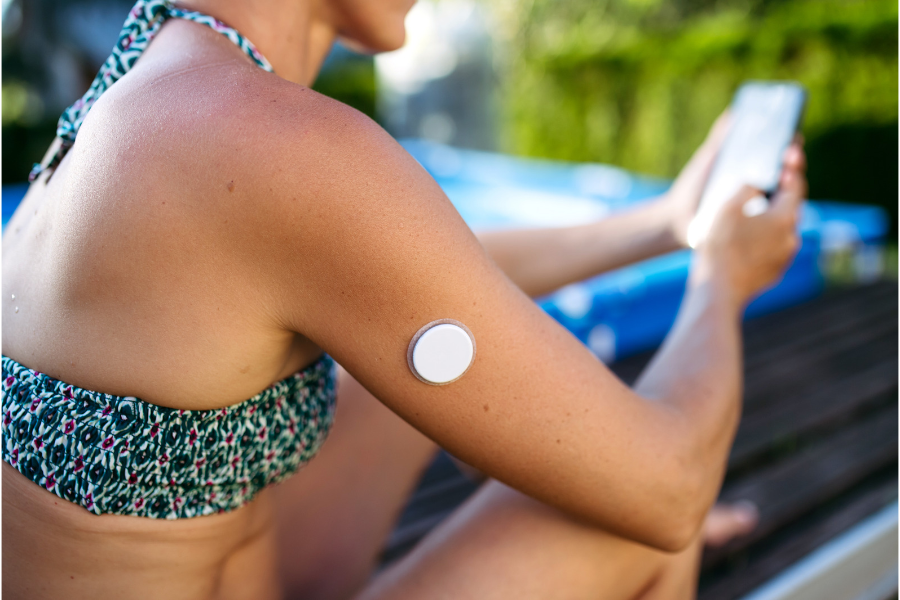
Athletes love data, and they have access to new and improving tools every year to monitor different metrics: Sleep, O2 saturation, core temperature, heart rate variability, and blood glucose are just a few of recent interest. For this discussion, let’s focus on blood glucose monitoring. With the use of Continuous Glucose Monitors (CGMs), athletes can obtain almost real-time data about their blood sugar levels. While not a new technology, the application of CGM data to athletes has expanded over the past several years. With available data comes increasing questions of how to interpret it for athletic performance. So, what are the applications and drawbacks of using Continuous Glucose Monitors?
A BIT OF HISTORY
CGMs were first released to market in 1999 and have been used to assist in the clinical management of diabetes. These medical devices provide users with a continuous measurement of interstitial glucose twenty-four hours per day. Inserted into the upper arm, CGM technology shows interstitial glucose responses, including responses to carbohydrate ingestion and physical activity. CGMs can also show nighttime interstitial glucose readings, allowing diabetics the opportunity to manage undesirable glucose changes appropriately through adjustments to dietary intake, medication, or insulin. This tool is incredibly useful for people with diabetes and their healthcare providers, as the device provides an opportunity to monitor and respond to glucose fluctuations quickly.
3 Key Points
CGMs were originally developed to help people with diabetes monitor and regulate blood sugar.
The sensor measures interstitial fluid, not blood plasma, and can show trends over 24 hours.
Nighttime data can be critical for adjusting diet, medication, or insulin.
OLD SCHOOL
Before CGMs were widely available, diabetic patients needed finger sticks or veinous blood draws to measure blood sugar. These methods provide a point-in-time reading of blood glucose. Versus the use of CGMs, which collect averages of interstitial glucose every 1–15 min, allowing patients to witness trends and directional changes. Importantly, CGM devices measure interstitial glucose rather than blood glucose. Meaning that a 5–10 min delay exists between actual blood glucose and reported CGM glucose readings.
3 Key Points
Traditional methods like finger pricks only provide a single-time snapshot of glucose levels.
CGMs offer continuous trend data (every 1–15 minutes).
A time lag of around 5–10 minutes exists between blood glucose and what CGM displays.
ATHLETE ADVANTAGE
Over the past few years, there’s been interest in real-time glucose monitoring for athletes, especially in endurance sports. It’s well accepted that sports performance is impaired by low carbohydrate availability, which can be defined as insufficient glycogen and inadequate blood glucose compared to fuel needs. Low carbohydrate availability is especially important in endurance events. Looking for a benefit in sports performance, it’s understandable why athletes are curious about tools like CGMs that measure biomarkers that may help them improve.
The challenge lies in reviewing and interpreting blood glucose readings in relation to performance. Companies that market CGMs to athletes offer blood glucose interpretations. These interpretations are tailored to sports and health nutrition goals. Companies claim that real-time glucose tracking can “optimize training and recovery, providing a minute-by-minute energy management system to ensure you will never bonk again” (this quote is from the now defunct company, Supersapiens). However, the issue is that blood glucose readings and their interpretation may not truly be a substitute measure for adequate fueling during exercise.
3 Key Points
Athletes must interpret CGM data within the broader context of performance.
Some companies promise robust performance gains from real-time glucose data.
Glucose measurements alone may not replace comprehensive fueling strategies.
THE UPSIDE
CGMs may have some beneficial uses. They are undoubtedly useful for diabetics and diabetic athletes, and they may be useful in detecting and preventing reactive hypoglycemia, where glucose concentrations drop at the onset of exercise following the intake of pre-workout carbohydrates.
The human body tightly controls blood glucose levels. Insulin is secreted when glucose is plentiful, and glucagon is released when blood sugar is low. After a meal, blood glucose rises, so the pancreas secretes insulin, signaling cells to uptake the glucose and use it as fuel. When glucose levels are low, glucagon is secreted, and various processes begin to create glucose from glycogen and other nutrients so that normal blood glucose levels are restored. Healthy people keep their glucose levels within a narrow, tightly controlled range.
3 Key Points
Blood glucose regulation is largely governed by insulin and glucagon.
The body has robust mechanisms to keep glucose levels stable.
Healthy individuals typically maintain glucose within a tight range naturally.
THE DRAWBACK
For a technology to be useful, an athlete must understand it and be able to use it appropriately. Due to the complexities of the interactions between carbohydrate intake, exercise, carbohydrate availability, overall energy availability, and endogenous glucose stores, further research is required to determine the usefulness of CGM technology. Our bodies are programmed to handle glucose; monitoring with a CGM doesn’t do anything to change how bodies regulate blood glucose.
3 Key Points
Successful use of CGMs requires proper user understanding and interpretation.
Multiple factors—beyond just glucose readings—affect performance and carbohydrate needs.
Monitoring glucose alone does not alter the body’s own regulatory processes.
THE DOWNSIDE
There’s an assumption that elevated or stable blood glucose concentrations during exercise equate to success in in-session carb intake. In the past, blood glucose numbers has been used as a stand-in measure for carbohydrate availability and utilization in sports performance. Of course, preventing hypoglycemia, providing supplemental energy, sparing muscle glycogen, and supporting liver glycogen storage are all good and necessary things. Yet, despite the marketing messages and anecdotal accounts of CGMs for these purposes, there is a lack of evidence that CGMs can identify optimal fueling practices or improve athlete fueling practices. Simply because monitoring blood glucose concentrations doesn’t tell the full story, CGMs cannot show the changes occurring from the release of liver glycogen, absorption of carbohydrates from the GI tract, or uptake of blood sugar into tissues.
Additionally, athletes may misinterpret normal blood glucose variations as cause for concern. For example, hyperglycemia (high blood sugar) after exercise can be a normal physiologic response and not the result of an incorrect fueling strategy. Some time points of blood sugar abnormalities are actually normal and not directly related to impaired fueling or energy usage. Having CGM data without appropriate context may cause athletes unwarranted concern. In some severe cases, athletes who misinterpret blood sugar readings could incorrectly compensate for normal episodes of hyperglycemia by avoiding food or deviating from an appropriate nutrition plan. Yes, CGM data could potentially help athletes in some rare cases, but CGM data shouldn’t be valued over an athlete’s own hunger cues or subjective training markers such as perceived exertion. Additionally, individuals respond differently to the ingestion of carbohydrates (Thomas et al., 2016). Therefore, athletes must be cautious when interpreting CGM data as a gauge for appropriate fueling during exercise.
3 Key Points
Blood glucose spikes (including post-exercise) can be normal and don’t always indicate fueling errors.
CGMs can’t differentiate between glucose sources (liver glycogen vs. ingested carbs).
Misinterpretation of CGM data can lead to inappropriate dietary adjustments or anxiety.
ANY EVIDENCE?
The most obvious downside to using CGMs is the lack of evidence supporting them. There is no scientific consensus on whether the availability of real-time blood sugar feedback actually produces quantifiable performance benefits. It is important to consider whether CGMs are sensitive enough to reflect subtle changes in fueling status and exercise that have meaningful implications on athlete health and performance
3 Key Points
Little scientific evidence proves CGMs boost performance in healthy athletes.
Real-time glucose feedback may not capture the intricate nuances of fueling in exercise.
The sensitivity and real-world impact of CGMs for sports remains questionable.
CONCLUSION
While CGMs offer athletes more data, the data’s value has limitations. While CGMs can be an important tool for diabetic athletes, their application in optimizing performance is still unclear. The complexities of glucose regulation during exercise indicate that blood glucose levels alone may not provide enough evidence to determine optimal fueling. Athletes must be cautious not to rely on CGM data and instead create nutrition and fueling strategies based on scientific evidence, subjective metrics, and practiced strategies.
REFERENCES
Bowler, A.-L. M., Whitfield, J., Marshall, L., Coffey, V. G., Burke, L. M., & Cox, G. R. (2022, December 26). The use of continuous glucose monitors in sport: Possible applications and considerations. Human Kinetics. https://journals.humankinetics.com/view/journals/ijsnem/33/2/article-p121.xml#r18
Bettin, A. (2023, November 28). Continuous glucose monitoring: Should athletes do it?. T
TrainingPeaks. https://www.trainingpeaks.com/blog/is-continuous-glucose-monitoring-for-athletes-worth-considering/
Perishable. (2023, April 7). Will continuous glucose monitoring improve my performance?. U.S. Anti-Doping Agency (USADA). https://www.usada.org/spirit-of-sport/glucose-monitoring-performance/
Thomas, T., Erdman, K.A., & Burke, L.M. (2016). Position of the academy of nutrition and dietetics, dietitians of Canada, and the American College of Sports Medicine: Nutrition and athletic performance. Journal of the Academy of Nutrition and Dietetics, 116(3), 501–528. https://doi.org/10.1016/j.jand.2015.12.006